Posts

Tear Gas, Pepper Spray, and Rubber Bullets: A Primer
Image
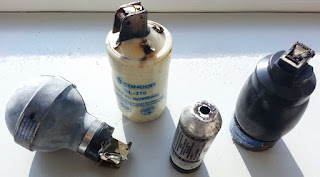
By James Chenoweth MD MAS Disclaimer: Any opinions expressed in this article are my own. Recent protests over the murder of George Floyd by police in Minneapolis, Minnesota have often been met with police use of “non-lethal” (better described less lethal) forms of crowd control/dispersal. The most common of these include tear gas, pepper spray, and impact rounds (beanbag rounds and rubber bullets). Emergency physicians and toxicologists should know what compounds these devices contain and the risks associated with their use by police. Tear Gas Tear gas is a heterogenous group of compounds that are irritant gases which cause coughing, eye irritation, and skin irritation upon exposure. The most common of these compounds in current us is CS (chlorobenzylidene malononitrile) gas. CS was developed in 1928 and is named after its creators, Corson and Stoughton. It was first used by the British Army in 1958 and was frequently used by the US military during the Vietnam War. 1 The mi...
I got an antibody test. What does it mean?

Image
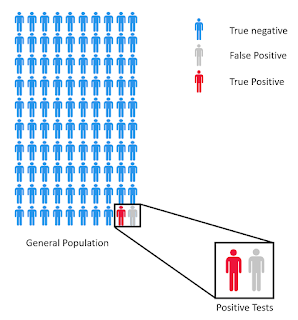
by James Chenoweth, MD MAS Disclaimer: I am not a statistician. I studied biostatistics during my master's program and have continued to study interpretation of medical research. I have avoided fractional positive/negative rates because they cause confusion and do not change the general principles discussed. Each test has its own test statistics and you should review those to help you interpret your results. There has been a lot of recent focus on antibody testing for possible prior infection with SARS-CoV-2. Non-random sampling of several populations has suggested that the numbers of confirmed cases may be significantly undercounting the actual number of infections.   If true, this could be good news. For one, it would suggest that the actual mortality number may be markedly lower than the current case fatality rates. It would also mean that a portion of the population could now be immune. However, before we get too excited, I think it is important to understand what these te...

Potential Treatments for SARS-CoV-2: Reported Mechanisms and Toxicity

Image
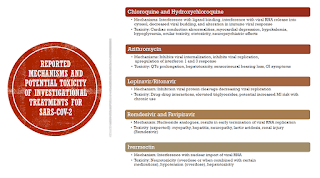
By James Chenoweth, MD MAS This review is intended to discuss possible mechanisms of different medications against the novel coronavirus SARS-CoV-2 along with the potential toxicity of these agents.   As of the writing of this document, there is insufficient evidence to recommend any of these as definitive treatment for SARS-CoV-2, although trials are ongoing.   I have not attempted to compile efficacy data as this information is rapidly changing. Chloroquine and Hydroxychloroquine Chloroquine and hydroxychloroquine are synthetic analogues of quinine, a naturally occurring extract from the bark of the Cinchona tree. Both are used as anti-malarial agents in regions without chloroquine resistance. Hydroxychloroquine is also used to treat auto-immune disorders such as rheumatoid arthritis and systemic lupus erythematosus. 1 Potential mechanisms against SARS-CoV-2 Chloroquine and hydroxychloroquine have been shown to alter the production of sialic acid moieties in vitro...